
CCTV laws UK: what homeowners and businesses must do

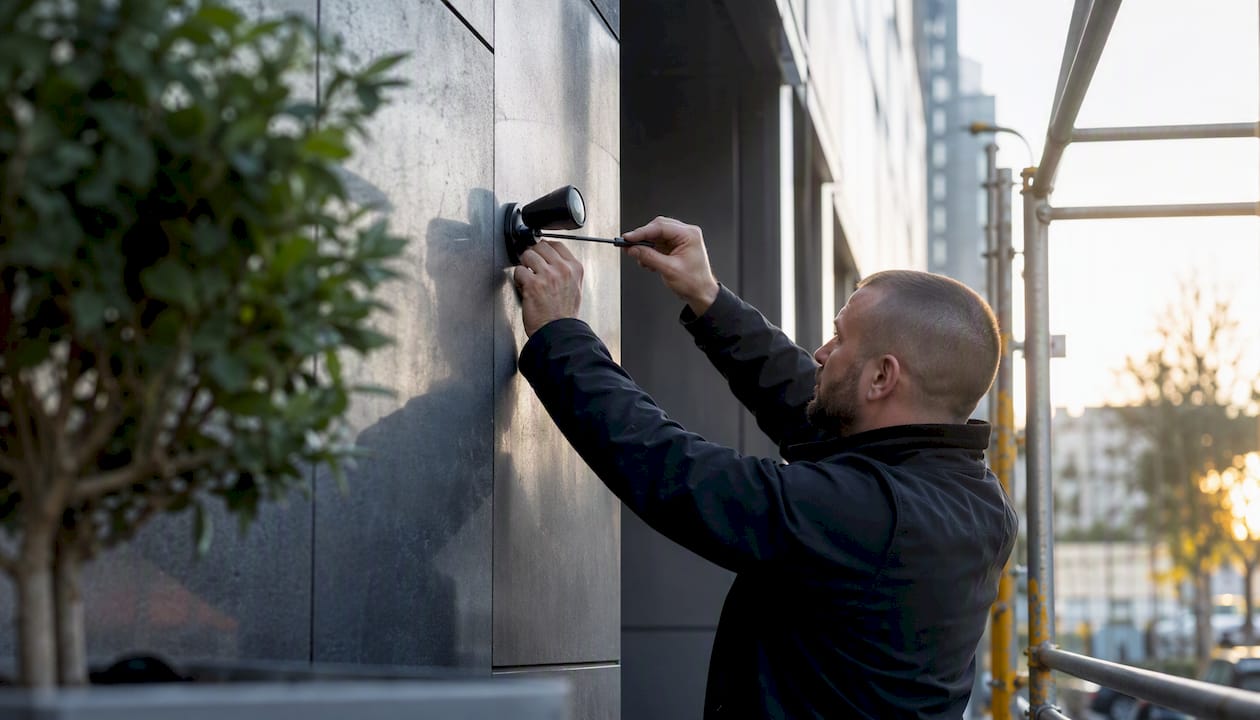
CCTV is entirely legal in the UK. The catch is that legal duties kick in the moment your camera captures images of anyone outside your own household, whether that is a neighbour’s driveway, a shared path, or a public pavement. Three actions matter most right now:
Homeowners: check whether your camera films beyond your property boundary. If it does, UK GDPR and the Data Protection Act 2018 apply and you become a data controller with real obligations.
Businesses: identify and document a lawful basis for processing footage before you switch the system on. Legitimate interests is the most common route, but it requires a written balancing test.
Everyone: put up visible signage before the monitored area, limit how long you keep recordings, and store footage securely with access restricted to those who genuinely need it.
Miss any of these and you risk a complaint to the Information Commissioner’s Office (ICO), a formal investigation, or a fine. The sections below walk through each obligation in plain terms.
Key takeaways
UK CCTV law requires every operator, homeowner or business, to document their purpose, minimise what they capture, display signage, and respond to subject access requests within one calendar month.
Point | Details |
Household exemption is narrow | Domestic cameras that capture neighbours, shared paths, or public areas trigger UK GDPR and the Data Protection Act 2018. |
Businesses need a written LIA | Document a Legitimate Interests Assessment before deployment and review it whenever use changes. |
Signage must come first | Place visible signs before every entry to a monitored area, including the controller’s name and a contact point. |
Retention: 7–31 days in practice | Set an automatic overwrite cycle and retain specific clips only when there is a documented reason to do so. |
Threesixtyfireandsecurity | Designs and installs compliant CCTV systems across England, with documentation support for businesses facing ICO or insurer scrutiny. |
Table of Contents
Which CCTV laws and regulators apply in the UK?
The legal framework is layered, and knowing which layer applies to you saves a lot of confusion.
Primary legislation
Data Protection Act 2018 and UK GDPR: the main statutory framework. Together they set the legal duties for processing personal data, including CCTV footage, and establish individual rights such as subject access requests (SARs). The UK GDPR is the retained EU GDPR text, incorporated into domestic law after Brexit.
Protection of Freedoms Act 2012 (PoFA 2012): created the Surveillance Camera Commissioner role and gave the Secretary of State power to issue the Surveillance Camera Code of Practice. It also introduced specific safeguards around DNA, fingerprints, and biometric data.
Statutory guidance
Surveillance Camera Code of Practice (SC Code): issued under PoFA 2012, this code defines surveillance camera systems and sets out twelve guiding principles for their use. Relevant authorities (police, local authorities, and similar public bodies) must have regard to it by law when operating overt systems in public places.
Regulators and oversight bodies
Information Commissioner’s Office (ICO): enforces data protection law. It can investigate complaints, issue enforcement notices, and levy fines. Its guidance on video surveillance is the most practical reference for day-to-day compliance.
Biometrics and Surveillance Camera Commissioner (BSCC): oversees the SC Code and publishes guidance on GOV.UK. The BSCC does not enforce data protection law directly but can review and report on public-sector compliance with the code.
Security Industry Authority (SIA): licenses individuals working as security operatives in public-facing roles. Where a business contracts staff to operate CCTV in a public-space environment, those operatives may require an SIA licence.
The ICO and BSCC roles are complementary rather than overlapping: the ICO handles data protection breaches; the BSCC handles adherence to the SC Code’s operational principles. Most homeowners and small businesses will only ever deal with the ICO.
Domestic CCTV: when does UK data protection law apply to your home system?
The short answer: the moment your camera captures images beyond your own property boundary, you are no longer protected by the household exemption.
The household exemption and when you lose it
UK GDPR contains a household exemption for purely personal or domestic use. A camera that films only the inside of your home, or your own garden with no view of shared or public space, falls within it. Once the lens captures a neighbour’s garden, a shared driveway, a communal hallway, or a public pavement, the exemption disappears. ICO guidance is explicit on this point: you become a data controller and the full data protection framework applies.
Practical steps before you install
Position cameras carefully. Angle them to cover only your own property. Most modern cameras allow you to set a privacy mask, a digital zone that blacks out a defined area of the frame. Use it to exclude neighbouring windows or public footpaths.
Put up a visible sign. Place it where someone approaching the monitored area will see it before they enter. It does not need to be large, but it must be legible and include your name (or a contact point) and the purpose of recording.
Set a retention limit. Delete or overwrite footage regularly. For most domestic systems, 7–14 days is proportionate unless you are keeping specific footage for an incident.
Secure the system. Change default passwords, restrict remote access, and keep the recorder in a locked location.
Tell your neighbours. You are not legally required to do so, but a brief conversation before installation prevents most complaints. Gov recommends minimising capture, providing signage, storing footage securely, and being prepared to respond to requests.
Handling a neighbour complaint
If a neighbour objects, the first step is a direct conversation. If that fails, GOV.UK sets out mediation routes for neighbour disputes before escalating to the ICO. The ICO can investigate if there is a genuine data protection concern, but it will expect you to have tried to resolve it directly first.
Subject access requests from neighbours
Anyone who appears in your footage has the right to request a copy of images in which they feature. You must respond within one calendar month. Before sharing anything, redact (blur or pixelate) any third parties who appear in the same clip. If providing the footage would reveal your own security setup in a way that creates a safety risk, you may be able to refuse on those grounds, but you must explain the refusal in writing.
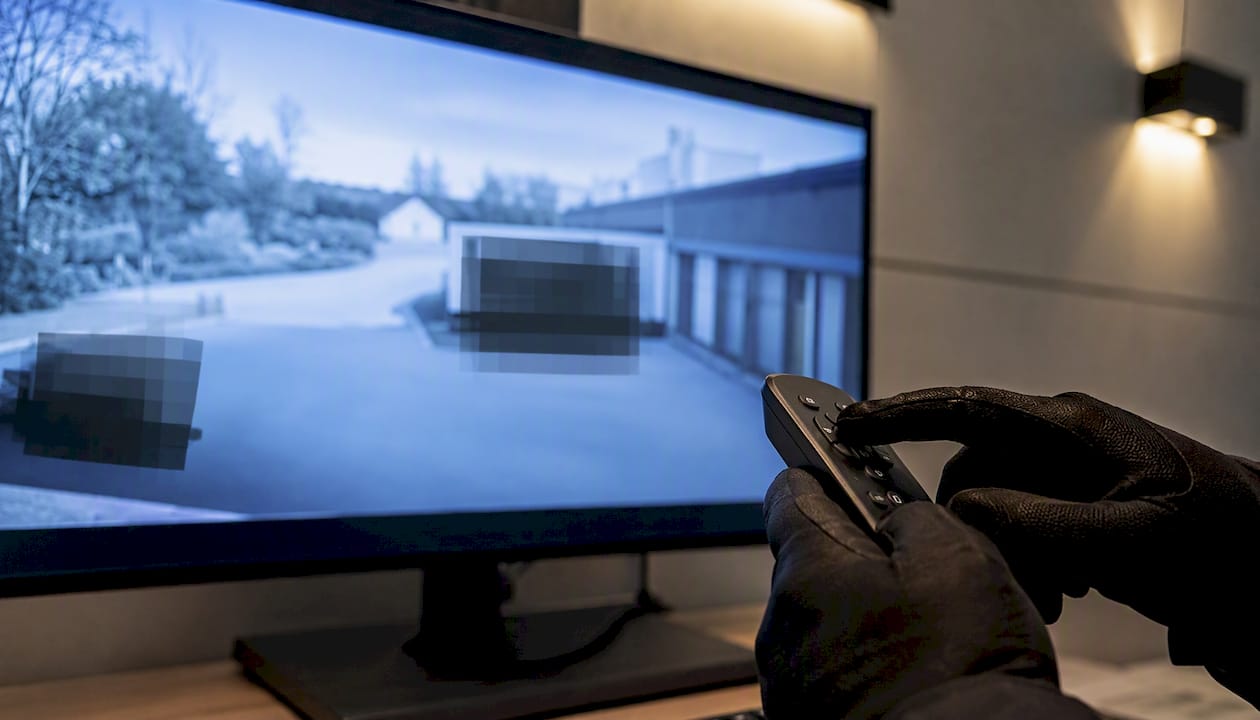
Pro Tip: Use your camera’s built-in privacy mask feature to digitally block out neighbouring windows or public areas before you finalise the installation. It takes minutes and removes the compliance risk entirely, without reducing your own coverage.
Business and workplace CCTV: what extra legal duties apply?
Any business that records people on CCTV is a data controller under UK GDPR. That is not optional and it is not a technicality. Here is what you must do.
Step 1: Identify and document a lawful basis
Most business CCTV deployments rely on legitimate interests under Article 6(1)(f) of UK GDPR. To use it lawfully you must carry out and record a Legitimate Interests Assessment (LIA), a three-part test:
Purpose test: is there a genuine legitimate interest (security, crime prevention, staff safety)?
Necessity test: is CCTV the least intrusive way to achieve it?
Balancing test: do your interests override the privacy rights of the people being filmed?
Document the LIA before you deploy by consulting Professional Property Inspection Reports for UK Visas. Review it whenever your use of the system changes materially.
Step 2: Decide whether a DPIA is required
A Data Protection Impact Assessment (DPIA) is mandatory under Article 35 of UK GDPR when processing is likely to result in a high risk to individuals. For CCTV, a DPIA is required when you are:
Monitoring staff systematically and continuously.
Using audio recording alongside video.
Deploying facial recognition or other biometric processing.
Operating large-scale surveillance covering public areas.
Even where a DPIA is not strictly mandatory, carrying one out is good practice and provides documented evidence of proportionality. The ICO’s guidance on surveillance systems covers the Article 5 principles, lawful basis under Article 6, special category data under Article 9, and DPIA requirements under Article 35 in detail.
Step 3: Register with the ICO and pay the data protection fee
Most organisations that process personal data must pay the ICO data protection fee. The fee tier depends on your organisation’s size and turnover. Some small organisations and sole traders qualify for an exemption, but operating CCTV that captures employees or members of the public rarely qualifies. Check the ICO’s self-assessment tool to confirm your position.
Step 4: Signage, retention, and access controls
Display clear signs before every entrance to a monitored area. Include the controller’s name, the purpose of recording, and a contact point or link to your privacy notice.
Set a written retention policy. Most business systems use automatic overwrite cycles of 7–31 days unless footage is flagged for an incident or investigation.
Restrict access to footage. Keep an access log recording who viewed what and when. Train anyone with access on their obligations.
Monitoring staff
Monitoring employees is lawful but carries additional obligations. Staff must be informed before monitoring begins; covert monitoring is only permissible in very narrow circumstances (typically a specific criminal investigation). Use footage only for the purpose for which it was collected. Disciplinary proceedings based on CCTV footage must follow a fair process, and the footage itself must be handled as personal data throughout.
Audio recording
Audio recording is significantly more intrusive than video and is rarely justifiable for routine surveillance. Continuous audio recording almost always requires a DPIA and a stronger lawful basis than video alone. The practical default is to disable audio unless there is a specific, documented reason to enable it, and even then to configure microphones as event-triggered rather than continuously recording.
Pro Tip: Keep your LIA and DPIA as living documents. A system installed for one purpose (stock room security) that later gets used for another (monitoring staff punctuality) needs a fresh assessment. Regulators look at actual use, not original intent.
Public-space surveillance, ANPR, and when the Surveillance Camera Code of Practice applies
Private businesses and public authorities face different obligations when cameras cover public space.
Relevant authorities and the SC Code
The Surveillance Camera Code of Practice applies as statutory guidance to relevant authorities under PoFA 2012, primarily police forces and local councils. These bodies must have regard to the code when deploying overt surveillance systems in public places. The code’s twelve principles cover necessity, proportionality, transparency, governance, and technical standards.
Private operators capturing public space
If your business CCTV captures a public pavement, road, or shared access area, you are not legally required to comply with the SC Code, but the ICO and BSCC both recommend voluntary adoption of its principles. In practice, following the code’s proportionality and transparency requirements is the clearest way to demonstrate that your system meets UK GDPR’s data minimisation and accountability obligations.
Limit the field of view to what is genuinely necessary for your stated purpose.
Document why public-space capture is unavoidable given your premises layout.
Review the system’s coverage at least annually.
ANPR systems
Automatic Number Plate Recognition (ANPR) systems capture vehicle registration data, which is personal data under UK GDPR. Operators face heightened scrutiny: the data must be processed for a specific, documented purpose; retention periods must be short and justified; and access must be tightly controlled. Public-authority ANPR deployments must also comply with the SC Code.
SIA licensing
Where a business contracts security operatives to monitor CCTV in a public-facing environment, those individuals may require an SIA Door Supervisor or Security Guard licence. The SIA licence requirement applies to the operative, not the equipment. If you are procuring a managed CCTV monitoring service, confirm that the provider’s operatives hold the appropriate SIA licences.
Facial recognition and biometric processing
When CCTV incorporates facial recognition, the system processes biometric data, which is special category data under Article 9 of UK GDPR. Operators must satisfy an additional condition under Schedule 1 of the Data Protection Act 2018 and almost always carry out a DPIA. The ICO has been clear that live facial recognition in public spaces carries a very high evidential bar for justification.
A practical compliance checklist for lawful CCTV operation
Work through these steps in order, whether you are a homeowner or a business.
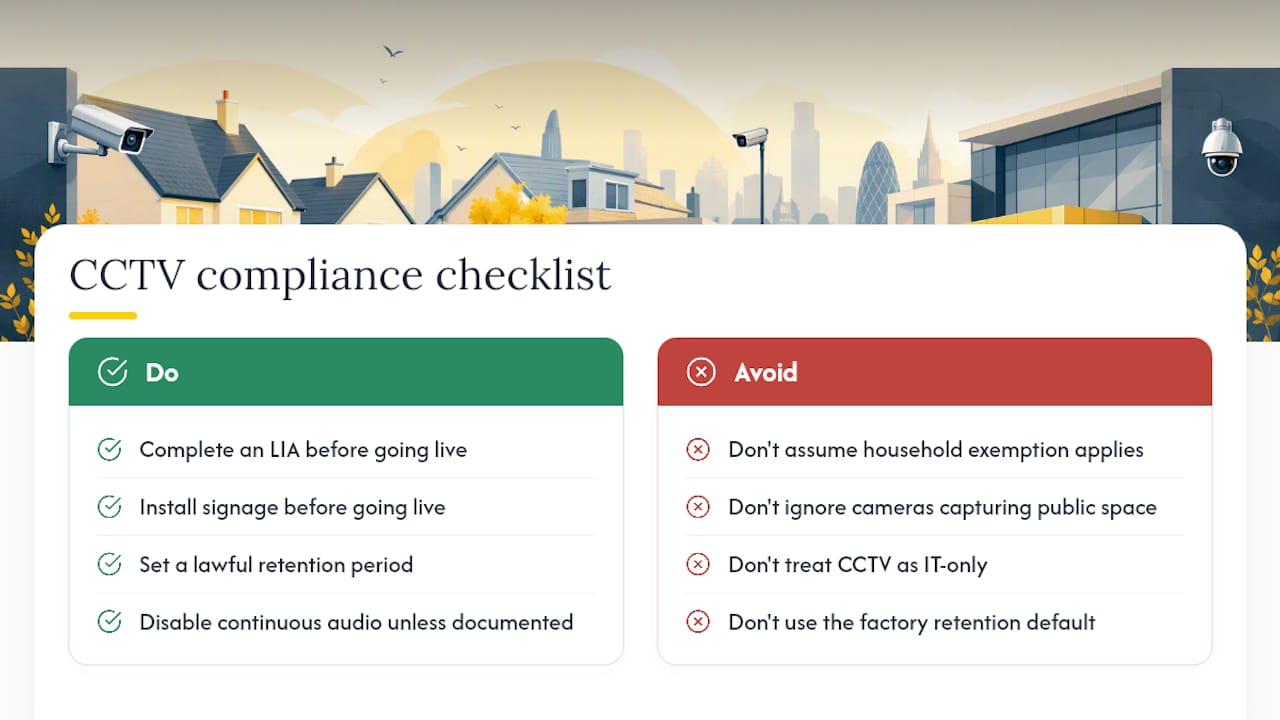
Define your purpose. Write down why you need CCTV and what specific risk it addresses. Vague purposes (“general security”) are harder to defend than specific ones (“prevent vehicle theft from the car park”).
Minimise what you capture. Position cameras to cover only the area necessary. Use privacy masks for neighbouring properties or public areas you cannot avoid.
Install signage before you go live. Place signs at every entry point to the monitored area. Include: the name of the data controller, the purpose of recording, and a contact point or privacy notice URL.
Set a written retention policy. Most systems should overwrite footage automatically after 7–31 days. Retain specific clips only when there is a documented reason (an incident, a SAR, or a law enforcement request).
Secure the system. Use strong, unique passwords. Encrypt recordings where possible. Keep recorders in a locked, access-controlled location.
Restrict and log access. Only authorised personnel should be able to view or export footage. Keep a log of every access event.
Carry out an LIA (businesses). Document your legitimate interests assessment before deployment and review it annually or when use changes.
Carry out a DPIA if required. Mandatory for high-risk processing; strongly recommended for any business system covering staff or public areas.
Train staff. Anyone who can access footage must understand their obligations under UK GDPR.
Schedule a review. Reassess the system’s purpose, coverage, and retention at least once a year.
For signage, the ICO recommends including at minimum: the identity of the data controller, the purpose of the surveillance, and how to obtain further information (a phone number, email address, or link to a privacy notice). A simple example: “CCTV in operation. Recorded for security purposes by [Your Name/Business]. For queries: [contact details] / [privacy notice URL].”
GOV.UK’s domestic CCTV guidance and the ICO’s own CCTV checklist are the best starting points for downloadable templates.
How to handle subject access requests, disclosures, and complaints
People have a legal right to request footage in which they appear. The clock starts the moment you receive the request.
Responding to a subject access request
Verify the requestor’s identity. Ask for enough information to locate the relevant footage (date, time, location) and confirm who they are. Do not ask for more than you need.
Locate the footage. Search your system for the relevant time window. Act quickly: footage on a rolling overwrite cycle may be deleted before the deadline if you delay.
Redact third parties. Before providing any footage, blur or pixelate anyone other than the requestor. Sharing unredacted footage of third parties without their consent is itself a data protection breach.
Respond within one calendar month. GOV.UK confirms this is the standard response window. You may extend by a further two months for complex requests, but you must notify the requestor within the first month that you are doing so.
Refuse where justified. You may refuse if providing the footage would adversely affect the rights of others and redaction is not practicable, or if the request is manifestly unfounded or excessive. Explain the refusal in writing and inform the requestor of their right to complain to the ICO.
Handling neighbour and public complaints
Ask the complainant to contact you directly first. If the complaint relates to a data protection concern and you cannot resolve it, the complainant can escalate to the ICO. The ICO can investigate, issue enforcement notices, and in serious cases levy fines. It cannot award compensation to individuals, but an ICO finding against you can support a civil claim.
Requests from police and law enforcement
When police or another law enforcement body requests footage, you are generally permitted to disclose it without breaching data protection law, provided the request is made for law enforcement purposes. Keep a written log of every disclosure: the date, the requesting officer or body, the footage provided, and the stated purpose. If the police ask you to preserve footage pending a formal request, do so and note it in your log. You are not obliged to hand over footage without a court order or formal request, but voluntary disclosure to prevent or detect crime is lawful.
When should you hire a professional CCTV installer?
Hire a professional when any of the following applies: you need the system to integrate with access control or intruder alarms; you are unsure whether your proposed camera positions comply with UK GDPR; you need a DPIA or LIA prepared as part of the installation; or you want a maintenance contract and warranty that holds up if something goes wrong.
Questions to ask any installer
Can you provide evidence that your installation practices comply with ICO guidance and the Surveillance Camera Code of Practice?
Do you carry out or support a DPIA for business installations?
Are your operatives SIA-licensed where required?
What are your data handling practices during installation and commissioning?
Do you carry professional indemnity and public liability insurance?
What does your maintenance SLA cover, and what is the response time for faults?
What to require in the contract
A written data processing agreement if the installer will have access to live or recorded footage.
Defined maintenance SLAs with response times for critical faults.
Confirmation of SIA licensing status for any operatives who will monitor footage on your behalf.
A right to audit clause if the installer manages an ongoing monitoring service.
Documentation of the system’s configuration, including camera positions, retention settings, and access controls, handed over at completion.
Threesixtyfireandsecurity has been designing and installing compliant CCTV systems across commercial, retail, hospitality, and educational properties since 2018. Every installation includes documented configuration records and, for business clients, support with the compliance documentation your insurer or regulator may ask to see. You can find more on the CCTV systems page or browse the full range of security services.
Pro Tip: Ask your installer to hand over a written record of every camera’s field of view, the retention period set on the recorder, and the access control configuration. If you ever face an ICO investigation or a SAR, that document is your first line of defence.
What most people get wrong about CCTV compliance
Most homeowners who install a doorbell camera or driveway CCTV assume that because they bought the equipment for personal use, the law does not apply to them. That assumption is wrong the moment the lens points at a shared path or a neighbour’s front door, and it is a mistake I see repeatedly.
The household exemption is narrower than it sounds. It covers genuinely domestic, inward-facing use. The second a camera captures public or shared space, you are operating as a data controller, with the same core obligations as a small business. The ICO does not distinguish between a homeowner with one camera and a shop with twelve when it comes to the right to be informed, the right of access, or the duty to store footage securely.
For businesses, the more common failure is treating CCTV as an IT decision rather than a legal one. A system gets installed, nobody writes an LIA, the retention period stays at the factory default of 30 days, and the signage goes up as an afterthought. That is not malicious; it is just what happens when compliance is not built into the procurement process. The fix is straightforward: treat the LIA and signage as prerequisites for going live, not as paperwork to catch up on later.
The one area where I think the guidance undersells the risk is audio. Continuous audio recording on a CCTV system is treated by many operators as a minor add-on. It is not. It substantially increases the regulatory risk, almost always triggers a DPIA requirement, and in a workplace context can expose an employer to claims under employment law as well as data protection law. Disable it unless you have a specific, documented reason to enable it.
Threesixtyfireandsecurity: compliant CCTV installation across England
Getting the legal framework right is one thing. Having a system that is physically installed to support compliance is another.
Threesixtyfireandsecurity designs, installs, and maintains CCTV systems for businesses, schools, retail premises, and residential properties across England, with every installation built around the ICO’s guidance from the outset. That means camera positions reviewed against UK GDPR data minimisation requirements, retention settings configured before handover, and full documentation provided so you have what you need for an audit, an insurer, or an ICO investigation. For business clients, the team supports DPIA preparation and can integrate CCTV with access control systems to manage who can view or export footage. Request a site survey or compliance review via the services page.
Sources
These are the primary references for forms, checklists, and statutory text.
Recommended
Comments