
CCTV for car parks: the UK compliance and spec guide

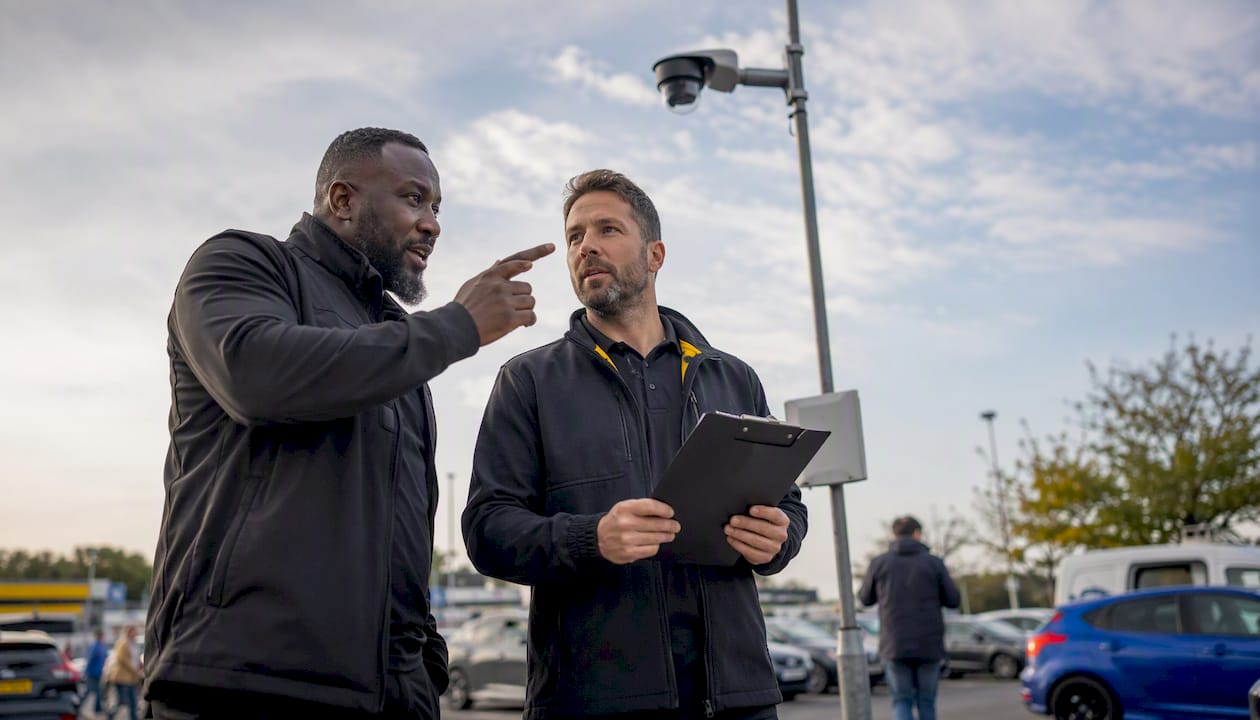
A compliant, effective car-park CCTV system must deliver four things simultaneously: reliable licence plate capture at every entry and exit point, evidential-quality face and incident footage in critical zones, secure storage with a documented retention schedule, and a recorded lawful basis under UK GDPR before a single camera goes live.
Getting any one of those wrong does not just weaken your security posture. It risks ICO enforcement, renders footage inadmissible in court, and exposes you to civil liability from the very incidents you were trying to prevent.
Immediate action checklist:
Commission a site survey that maps sightlines, power routes, and blind spots before specifying any equipment
Begin your Data Protection Impact Assessment (DPIA) in parallel with the survey, not after installation
Specify a minimum of 4MP resolution for general surveillance cameras and dedicated ANPR/LPR optics for entry and exit lanes
Decide on your monitoring model (ARC, onsite, or hybrid) before finalising camera placement
Document your lawful basis, retention period, and signage plan before cameras become operational
Threesixtyfireandsecurity designs, installs, and maintains car-park CCTV systems across the UK, covering everything from initial site survey through to DPIA support and ongoing maintenance contracts.
Table of Contents
UK legal requirements for car-park CCTV: what you must document
What camera types and specs should you demand for a car park?
When does ANPR add value, and what extra obligations does it create?
How should you manage recording, storage, and cybersecurity?
What maintenance and testing routines should you build into your contract?
How does CCTV integrate with access control, lighting, and alarms?
What training do CCTV operators and security personnel need?
What does a car-park security audit look like before CCTV design?
What specific challenges do car park environments create for CCTV?
What installers actually see go wrong on car-park CCTV projects
Threesixtyfireandsecurity: car-park CCTV design, installation, and maintenance
Why does CCTV for car parks need a different approach?
Car parks present a specific combination of risks that generic building cameras are not designed to handle. Theft from vehicles, vandalism, misuse of disabled or reserved bays, obstruction of emergency access routes, and drive-offs without payment all require different camera placements, optics, and response workflows than a standard office or retail installation.
The operational stakes are also higher. A car park that cannot produce clear, timestamped footage of a vehicle entering and exiting has no enforceable evidence for a disputed overstay charge or a damage claim. A camera that captures a blurred plate is worse than useless in a criminal investigation — it creates the appearance of coverage without the substance.
Beyond security, well-designed car park surveillance cameras support revenue protection (linking entry/exit times to payment records), flow analysis (identifying congestion points), and emergency access monitoring. These operational benefits justify a higher specification than most property owners initially budget for.
The admissibility point matters more than most managers realise. Footage that is legally obtained, properly retained, and documented under a clear lawful basis is evidence. Footage captured without those foundations is a liability. The ICO’s guidance on CCTV makes clear that the operator bears responsibility for both the quality and the legality of what is recorded.
UK legal requirements for car-park CCTV: what you must document
UK GDPR requires property owners operating CCTV to establish and document a lawful basis for processing personal data, complete a DPIA where the processing is likely to result in high risk, provide clear privacy notices, and limit retention to what is strictly necessary. Failure to meet any of these obligations exposes you to ICO enforcement action.
The core compliance checklist
Lawful basis: For most commercial car parks, the lawful basis is legitimate interests. Document this formally, including a Legitimate Interests Assessment (LIA) that weighs your interests against the privacy rights of individuals using the car park.
DPIA: Required where CCTV covers a large public area, processes special category data, or involves ANPR. Complete it before installation, not after.
Privacy notices and signage: Signs must be visible at every entry point and at intervals throughout the car park. Each sign should name the data controller, state the purpose of recording, and provide contact details or a URL for the full privacy notice.
Retention and access policy: Set a defined retention period, document it, and enforce it technically. Footage should not be retained longer than necessary for the stated purpose.
Access logs: Every instance of footage being accessed, exported, or reviewed must be logged, including who accessed it, when, and why.
NSI and SSAIB accreditation: Installers accredited by the National Security Inspectorate (NSI) or the Security Systems and Alarms Inspection Board (SSAIB) work to recognised standards. Specifying an accredited installer strengthens your compliance position and is often required by insurers.
What triggers ICO enforcement
The ICO’s most common enforcement triggers in CCTV cases are over-retention (keeping footage beyond the stated period), unclear or absent purpose documentation, failure to respond to subject access requests, and inadequate physical or cyber security around stored footage. None of these are technical failures. They are administrative ones, and they are entirely preventable with a written policy and a maintenance schedule that includes compliance checks.
Pro Tip: Keep your DPIA, retention policy, and signage audit in a single project file alongside the as-fitted drawings. If the ICO ever requests documentation, having everything in one place demonstrates that compliance was designed in, not bolted on.
What camera types and specs should you demand for a car park?
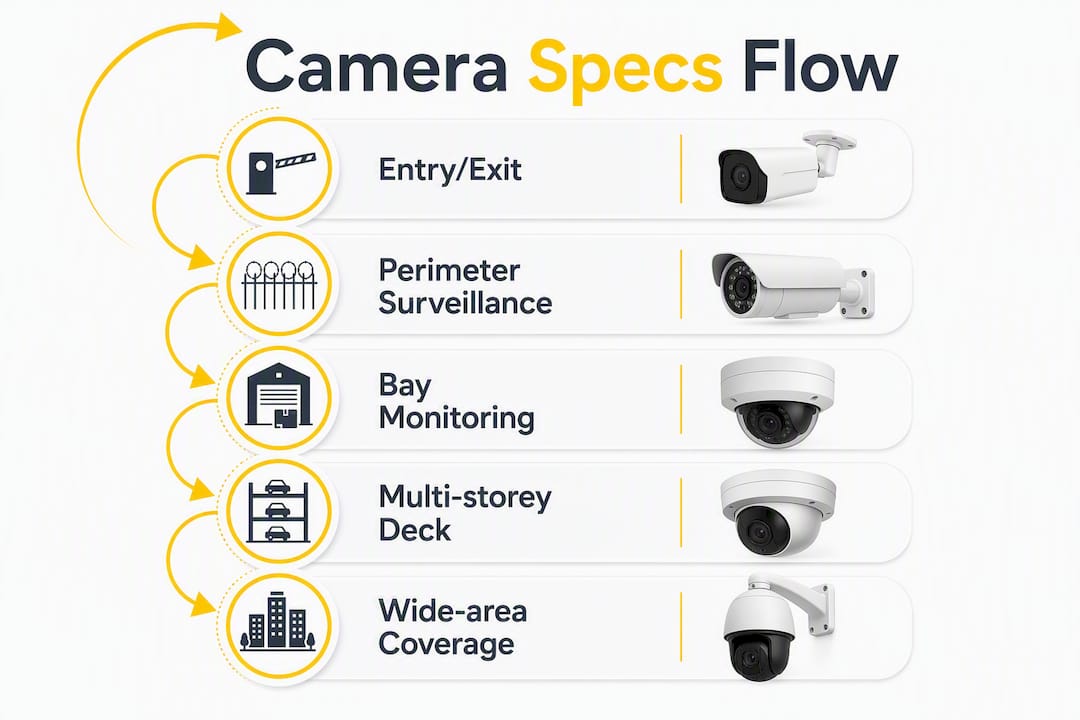
The answer depends on the zone. Entry and exit lanes need fundamentally different optics from wide-area bay monitoring, and high-risk zones such as stairwells and payment kiosks need different again.
Camera types by role
ANPR/LPR cameras at entry and exit points are non-negotiable for any car park that needs to link vehicle identity to time of entry, payment, or permit status. These are purpose-built units with telephoto lenses, high-speed shutters, and IR illumination tuned for plate reflectivity. Purpose-built ANPR cameras include tuned shutter control and plate-optimised optics that general-purpose cameras simply cannot replicate.
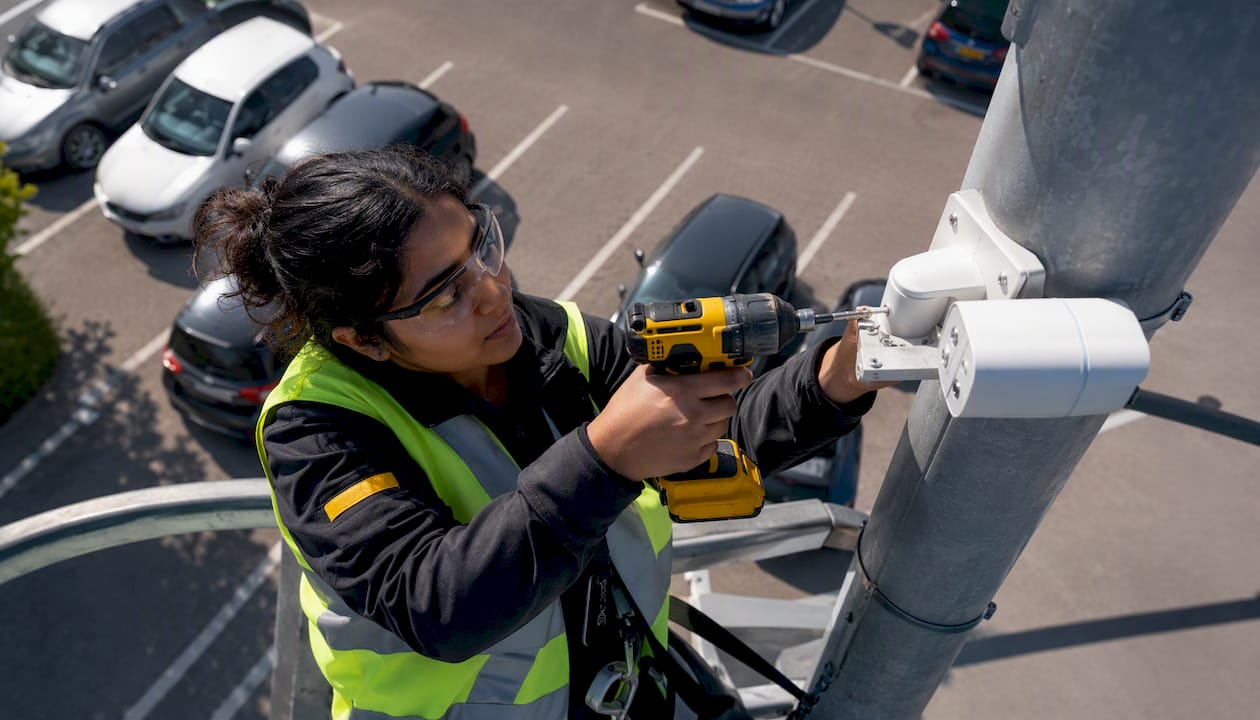
Bullet cameras suit perimeter coverage and long-corridor sightlines where a fixed field of view is appropriate. Choose models with wide dynamic range (WDR) rated at 120dB or above for locations where headlights or direct sunlight create contrast problems.
Dome cameras work well for bay-level monitoring and internal multi-storey decks where vandal resistance (IK10 rating) matters as much as image quality. Their discreet profile also deters tampering.
PTZ (pan-tilt-zoom) cameras are worth specifying for large open-air car parks where an operator or automated trigger needs to track an incident across a wide area. They should not be the primary coverage tool — they are a response asset, not a surveillance one.
360° and AI-enabled wide-area cameras can reduce device count in large open bays. AI-powered monitoring systems can scan multiple zones simultaneously and flag misuse in real time, which changes the economics of coverage for larger sites.
Minimum specification table
Parameter | Minimum specification | Notes |
Resolution (general surveillance) | 4MP (2688 × 1520) | — |
Resolution (ANPR/LPR) | 2MP minimum, 4K preferred | Higher resolution extends read range |
Frame rate | — | 30fps for high-traffic entry lanes |
Shutter speed (ANPR) | 1/1000s or faster | Prevents motion blur on moving plates |
Wide dynamic range | 120dB minimum | Essential for headlight/sunlight environments |
Low-light sensitivity | — | IR illumination as backup |
IR range | 30m minimum | Match to lane length or sightline |
Ingress protection | IP66 minimum | IP67 for flood-risk or wash-down areas |
Vandal resistance | IK10 | Mandatory for accessible mounting heights |
PoE standard | PoE+ power supply | Ensures power for IR and heaters |
Cybersecurity | Signed firmware, secure boot, HTTPS | NCSC Cyber Essentials alignment recommended |
Network infrastructure matters as much as the cameras themselves. Larger sites benefit from a fibre backbone to avoid bandwidth bottlenecks. For remote bays where trenching is cost-prohibitive, solar-powered and 4G-enabled units offer a practical alternative that avoids expensive civils work.
When does ANPR add value, and what extra obligations does it create?
Automated Number Plate Recognition (ANPR) is worth specifying wherever vehicle identity needs to be linked to time, payment, or permit data. That covers most commercial car parks, hospital sites, retail parks, and any location where overstay enforcement or access control is part of the operational model.
The practical benefits are clear: ANPR automates entry/exit timing, flags overstays without manual review, supports permit enforcement, and creates an auditable link between vehicle presence and payment records. High-zoom 4K ANPR cameras now combine plate recognition with vehicle make and model classification at the edge, reducing server dependency and improving response times.
ANPR-specific data obligations
Plate data is personal data under UK GDPR. A vehicle registration number can identify an individual, which means ANPR systems trigger the same compliance obligations as any other CCTV, plus some additional ones:
A DPIA is almost always required for ANPR, regardless of site size
Plate data must be retained only for the minimum period necessary for the stated purpose (typically 24–72 hours for general occupancy monitoring, longer where enforcement or investigation is ongoing)
Access to ANPR databases must be role-restricted and logged
If plate data is shared with a third-party enforcement company, a data processing agreement is required
Permit lists and exemption lists must be kept accurate and reviewed regularly to avoid wrongful enforcement
Technical demands specific to ANPR
Generic security cameras consistently fail at plate capture in real-world conditions. Dedicated LPR/ANPR optics are required for consistent capture at speed — expecting a standard dome camera to read plates reliably at a busy exit lane is a procurement mistake that costs more to correct than to avoid.
Key technical requirements: telephoto lens matched to lane width and read distance, shutter speed of 1/1000s or faster, IR illumination with headlight filters to prevent wash-out, and either edge-based ANPR processing or a low-latency server connection. Edge processing limits the transmission of personal data across the network, which is a data minimisation benefit worth noting in your DPIA.
Pro Tip: Before signing off any ANPR system, test plate-read success rates at peak ingress and egress speeds, in both daylight and at dusk with headlights active. A system that reads 95% of plates in a demo environment but drops to 70% in live conditions is not fit for enforcement purposes.
How should you place and mount cameras in a car park?
Placement decisions made at the design stage determine whether footage is evidential or merely decorative. Getting them wrong after installation means either living with blind spots or paying for a partial reinstall.
Mounting height and tilt
Mounting cameras at approximately 2.7–3 m (around nine feet) balances two competing needs: high enough to deter physical tampering, low enough to capture faces and plates at a useful angle. Above 4 m, face capture degrades significantly unless you are using a high-resolution camera with a steep downward tilt, which introduces its own distortion problems.
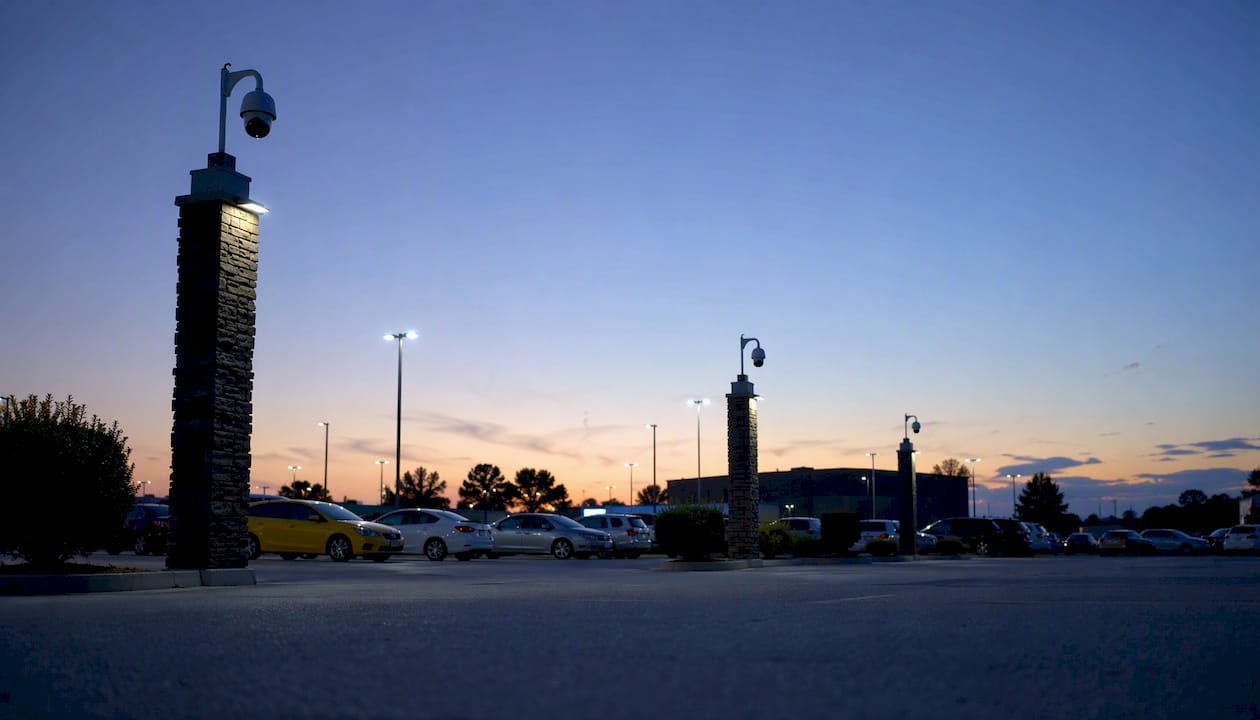
Tilt angle should be set so the camera’s field of view covers the target zone without excessive sky or ceiling in the frame. For ANPR lanes, the camera axis should be as close to horizontal as the mounting position allows, typically within 15–20 degrees of the vehicle’s direction of travel.
Lighting design
Uniform lighting is more important than high lux levels. A car park with 50 lux uniformly distributed produces better footage than one with 200 lux spotlights creating deep shadows between bays. Target a minimum of 20 lux at ground level for general surveillance zones, and 50 lux at ANPR capture points.
Avoid positioning cameras where they face direct sunlight or oncoming headlights without WDR compensation. IR filters on ANPR cameras mitigate headlight wash-out, but they are not a substitute for good lighting design.
Tamper resistance and physical security
Poles and columns should be steel or reinforced concrete; avoid hollow aluminium profiles that can be bent or cut
All cable runs should be in armoured conduit or steel trunking from camera to junction box
Fit surge protection at each camera and at the NVR/DVR to protect against lightning strikes
Shock detection (vibration sensors) on camera housings provides an early warning of tampering attempts
IK10-rated housings are the minimum for any camera mounted below 3 m
Installation specification table
Zone | Camera type | Mounting height | Lens focal length | Expected capture range |
Entry/exit lane (ANPR) | LPR bullet | 1.2–1.8 m (lane-level) | 8–16mm telephoto | 3–8 m read distance |
Bay-level monitoring | Dome (IK10) | 2.7–3 m | 2.8–4mm wide-angle | 6–10 m bay coverage |
Perimeter/access road | Bullet (WDR) | 3–4 m | 4–8mm | 15–25 m sightline |
Stairwell/lift lobby | Dome (IK10) | 2.5–3 m | fisheye or wide-angle lens | Full lobby coverage |
PTZ overview | PTZ | 4–6 m | Variable (optical zoom) | Site-dependent |
Pro Tip: Conduct a live plate-read and face-capture test at the actual site before final sign-off. Walk the car park at dusk with a vehicle moving at typical speeds and review the footage immediately. Problems found at commissioning cost a fraction of what they cost post-handover.
Which monitoring model suits a car park?
The right monitoring model depends on the size of the site, the hours of operation, the risk profile, and the budget available for ongoing costs.
ARC (Alarm Receiving Centre) monitoring connects your CCTV system to a staffed monitoring centre that receives video alarm activations, validates them, and escalates to a response. The key advantage is 24/7 coverage without the cost of onsite guards. The limitation is response time: an ARC can dispatch a patrol or contact police, but physical intervention takes minutes, not seconds.
Onsite security personnel provide immediate physical response but are expensive for round-the-clock coverage and introduce human reliability variables. They work best as a complement to ARC monitoring rather than a replacement.
Automated video alarm systems use analytics to detect specific behaviours (loitering, perimeter breach, vehicle left unattended) and trigger alerts without requiring continuous human monitoring. AI analytics have materially improved the accuracy of these detections, reducing false alarm rates that previously made automated systems impractical for busy car parks.
CCTV towers are self-contained, rapidly deployable units combining cameras, lighting, and sometimes audio deterrence. They suit temporary sites, construction compounds, or overflow car parks where permanent infrastructure is not viable.
Operational workflow for a video alarm event
Analytics engine detects trigger event (e.g., loitering beyond threshold time)
ARC operator receives validated video clip and reviews in real time
Operator activates automated response: lighting increase, audio challenge (“You are being monitored”)
If behaviour continues: patrol dispatch or police referral with timestamped footage
Event logged with footage clip, operator notes, and response outcome
SLA checklist for monitoring providers
Maximum validation time from alarm trigger to operator review (target: under 60 seconds)
False alarm rate and how it is measured
Police URN (Unique Reference Number) status — required for police response to CCTV activations
Footage retention at the ARC (separate from your own retention policy)
Escalation protocol and documented response tiers
How should you manage recording, storage, and cybersecurity?
Storage is where compliance and operational effectiveness intersect. Too little storage forces early overwriting and destroys evidence. Too much, retained without a policy, creates a data protection liability.
Retention planning
UK guidance suggests planning for a minimum of 30 days’ retention for typical car parks, with larger or higher-risk sites using 90 days or more for specific operational requirements. The right figure for your site depends on your stated purpose, the nature of incidents likely to be investigated, and any contractual obligations with tenants or insurers.
Factors that justify longer retention: ongoing investigations, tenancy agreements requiring evidence preservation, sites with a history of organised crime, and ANPR systems linked to enforcement proceedings.
Storage architecture
A hybrid approach combining on-site NVR/DVR storage with encrypted cloud backup is the most resilient architecture for most UK car parks. On-site storage provides fast access for day-to-day review; cloud backup protects against physical theft or damage to the recording equipment itself.
Calculate storage requirements before specifying hardware. The key variables are: number of cameras, resolution, frame rate, compression codec (H.265 is significantly more efficient than H.264 for the same quality), and retention period. A 16-camera site recording at 4MP, 15fps, using H.265 compression will require substantially less storage than the same site using H.264 at the same settings.
Cybersecurity essentials
Change all default credentials on cameras, NVRs, and network switches before the system goes live
Segment the CCTV network from the main IT network using a dedicated VLAN
Use a VPN for all remote access to the system; never expose NVR management interfaces directly to the internet
Apply firmware updates promptly; subscribe to manufacturer security advisories
Align with NCSC Cyber Essentials as a baseline framework for access control and patch management
Maintain an encrypted backup of configuration files and camera orientation data
Security and compliance checklist
Encrypted storage (AES-256 minimum for cloud; hardware encryption for on-site NVRs)
Role-based access with individual user credentials (no shared logins)
Automated access logs retained for at least 12 months
Documented breach response plan naming the DPO or responsible person
Scheduled quarterly audit of access logs and retention compliance
What should you ask an installer before signing a contract?
Procurement decisions made without the right questions produce systems that look complete on paper but fail in practice. These are the questions and deliverables that separate a competent installer from one who will leave you with a compliance gap.
Procurement checklist
Written scope of works including civils (trenching, conduit, pole installation) and confirmation of who is responsible for each element
Evidence of NSI or SSAIB accreditation and current insurance certificates
At least two references from comparable car-park installations, with permission to contact them
Confirmation of which camera models will be installed and their full datasheets
Written warranty terms for hardware and installation workmanship (minimum two years)
Technical and operational questions to ask
“Can you demonstrate plate-read success at the specified read distance, at dusk, with headlights active, before final sign-off?”
“What is your firmware update policy, and how will updates be applied during the warranty period?”
“How will the system be segmented from our main IT network?”
“What is included in the handover pack, and will it include as-fitted drawings and camera orientation photographs?”
“What maintenance schedule do you recommend, and what does your service contract cover?”
Contractual items to require
As-fitted drawings with camera positions, cable routes, and equipment locations
Camera orientation photographs taken at commissioning
Configuration report listing all camera settings, NVR settings, and network configuration
DPIA support: confirmation that the installer will provide the technical information you need to complete your DPIA
Maintenance schedule with defined response times for faults (target: next business day for non-critical, four hours for total system failure)
Evidence-retention commitments: written confirmation of how long footage will be accessible and the process for emergency export
Evaluation criteria
Weight your evaluation across four dimensions: technical fit (do the specified cameras meet the minimum spec table above?), compliance approach (does the installer understand UK GDPR obligations and can they support your DPIA?), ongoing support (what does the maintenance contract actually cover?), and total cost of ownership over five years, not just the installation price.
What does a car-park CCTV project typically cost?
There is no single answer, but there are honest ranges. The variables that move costs most are site size, existing infrastructure, lighting works required, and whether ANPR is in scope.
Cost categories
Camera hardware: General surveillance cameras typically range from £150 to £600 per unit depending on specification. Purpose-built ANPR cameras carry a premium, often £500–£1,500 per unit, reflecting the specialised optics and processing.
Cabling and civils: For sites requiring trenching, expect cabling and groundworks to represent 30–50% of the total project cost. PoE over existing cable infrastructure is significantly cheaper; solar/4G units for remote bays avoid civils entirely.
Installation labour: Varies by site complexity, access requirements, and whether working at height is involved.
NVR/storage hardware: Scales with camera count and retention period. Budget for adequate storage upfront; retrofitting larger drives later costs more than specifying correctly at the outset.
Monitoring fees: ARC monitoring is typically charged monthly, with rates varying by response tier and validation standard.
Maintenance contracts: Annual contracts covering preventive maintenance visits, firmware updates, and fault response are a recurring cost that should be budgeted from day one.
Budgeting tips
Invest in adequate optics and lighting before cutting costs on camera count. A smaller number of correctly specified cameras produces better evidence than a larger number of under-specified ones. Lighting works are often the most underestimated line item in a car-park CCTV budget.
Pro Tip: When calculating total cost of ownership, include firmware and cybersecurity lifecycle costs, planned camera replacements at year five to seven, and spare-parts availability for the models you specify. A camera that is discontinued two years after installation creates a compliance and operational risk when it can no longer receive security updates.
What maintenance and testing routines should you build into your contract?
A car-park CCTV system that is not actively maintained degrades faster than most property owners expect. Lens contamination, IR LED failure, storage drive degradation, and firmware vulnerabilities all accumulate silently until a footage request reveals the gap.
Recommended maintenance cadence
Daily: Automated health checks confirming all cameras are online and recording; alerts for any offline units
Monthly: Manual review of a sample of footage from each camera to confirm image quality, correct timestamp, and adequate lighting at night
Quarterly: Physical lens and IR illuminator inspection and cleaning; check of all cable terminations and housing seals; firmware review against manufacturer advisories
Annual: Full site audit including ANPR read-rate testing, storage capacity review, access log audit, DPIA review, and signage condition check
KPIs to track
System uptime: Target 99.5% or above across all cameras
ANPR read rate: Track successful plate reads as a percentage of vehicle movements; investigate if it drops below 95%
Mean time to restore (MTTR): How long it takes to restore a failed camera to service; target next business day for non-critical units
SLA compliance: Percentage of maintenance visits and fault responses completed within contracted timeframes
What to record in maintenance logs
Every maintenance visit should produce a written record covering: cameras inspected and their condition, any faults found and corrective actions taken, firmware versions checked and updated, footage integrity samples reviewed, and who carried out the work. These logs are what you produce if the ICO requests evidence of ongoing compliance or if footage is challenged in court.
How does CCTV integrate with access control, lighting, and alarms?
A car-park CCTV system that operates in isolation from other security systems misses most of its potential value. Integration is where the real operational gains come from.
Access control linked to CCTV creates a verified audit trail: when a barrier or gate opens in response to a credential, the associated camera captures the vehicle and occupants at that moment. This pairing is particularly valuable for permit enforcement and for investigating incidents where access credentials were misused.
Intruder alarm integration allows CCTV to be triggered by alarm zones, so a perimeter breach automatically starts high-frame-rate recording on the relevant cameras and sends a validated clip to the ARC. This reduces the volume of footage that needs to be reviewed and improves the speed of response.
Lighting integration is arguably the most operationally significant. Motion-triggered lighting that activates in response to CCTV analytics detections serves two purposes: it improves image quality for the recording and acts as a deterrent. A car park that floods with light when someone lingers near a vehicle is a less attractive target than one that stays uniformly dim.
For sites with fire alarm systems, CCTV integration supports evacuation monitoring and emergency access management, confirming that routes are clear and that emergency vehicles can reach the site without obstruction.
The practical integration requirement is an open platform NVR or VMS (Video Management System) that supports API connections to third-party access control and alarm panels. Proprietary closed systems that cannot integrate are a long-term liability.
What training do CCTV operators and security personnel need?
Operating a CCTV system without adequate training is a data protection risk, not just an operational one. The ICO expects operators to understand their obligations, and footage reviewed or exported by an untrained operator can be challenged on procedural grounds.
Minimum training requirements
Anyone with access to live or recorded footage should be trained on:
The lawful basis for processing and what it means in practice (what footage can and cannot be used for)
Subject access request (SAR) procedures: how to respond, what to disclose, and the 30-day response deadline
Footage export procedures: how to export footage without compromising the chain of custody
Access log requirements: every review must be logged with purpose and outcome
Data breach recognition and reporting: what constitutes a breach and who to notify (the DPO, and potentially the ICO within 72 hours)
Operational procedures
Written standard operating procedures (SOPs) should cover: how to respond to a footage request from police or solicitors, how to handle a subject access request, the escalation path for a suspected data breach, and the process for reviewing and approving access to footage by third parties.
Security personnel operating PTZ cameras or monitoring live feeds need additional training on privacy zones (areas that must be masked in the system, such as neighbouring properties or public highways outside the car park boundary) and on the limits of their authority to direct camera movements.
Refresher training should be scheduled annually and whenever the system is significantly upgraded or the retention policy changes.
What does a car-park security audit look like before CCTV design?
Starting CCTV design without a formal risk assessment produces a system shaped by guesswork rather than evidence. The audit is the foundation that every subsequent decision rests on.
A car-park-specific security audit should cover:
Threat and vulnerability assessment: What incidents have occurred on or near the site in the past 12–24 months? What are the realistic threat vectors (opportunistic theft, organised crime, anti-social behaviour, drive-offs)? Are there specific bays, access points, or times of day that account for a disproportionate share of incidents?
Physical survey: Walk every part of the car park at different times of day, including dusk and after dark. Identify existing blind spots, lighting deficiencies, and locations where cameras would be vulnerable to tampering. Note the positions of emergency exits, payment kiosks, and pedestrian routes.
Infrastructure assessment: Map existing power and data routes. Confirm whether the electrical supply can support the planned camera density and any associated lighting upgrades. Identify where trenching would be required and whether solar/4G alternatives are viable for remote areas.
Stakeholder consultation: Talk to the people who use and manage the car park daily. Security personnel, parking attendants, and even regular users often know where the problems are before any camera is installed.
The output of the audit is a risk register and a coverage map that directly informs the camera placement plan. Skipping this step and designing from a floor plan alone is one of the most common and expensive mistakes in car-park CCTV projects.
What specific challenges do car park environments create for CCTV?
Car parks are among the most technically demanding environments for surveillance cameras. The combination of weather exposure, high-contrast lighting, physical accessibility, and structural complexity creates problems that do not appear in most other settings.
Weather and ingress protection: External car parks expose cameras to rain, frost, condensation, and UV degradation. IP66 is the minimum; IP67 is preferable for sites in flood-risk areas or where pressure washing is used for cleaning. Internal multi-storey decks are not immune: condensation and vehicle exhaust create their own ingress risks.
Lighting contrast: The transition between a bright exterior and a shaded interior deck, or between daylight and headlights at night, creates extreme contrast ratios that standard cameras cannot handle. WDR rated at 120dB or above is not optional in these environments.
Vandalism and physical attack: Cameras mounted at accessible heights in car parks are a target. IK10-rated housings, armoured cable runs, and shock detection are practical mitigations. Visible deterrence (prominent housing, warning signage) reduces attack frequency.
Blind spots in structural environments: Columns, ramps, and low ceilings in multi-storey car parks create sightline problems that cannot always be solved with a single camera. The solution is overlapping coverage from multiple angles, which requires more cameras than a flat open-air site of equivalent area.
Remote and temporary sites: Overflow car parks, event sites, and construction compounds often lack permanent power and data infrastructure. Solar-powered and 4G-enabled deployments address this, but they require careful power budgeting and network planning to maintain uptime and footage quality.
Key takeaways
A compliant, effective car-park CCTV system requires purpose-specified cameras, a documented UK GDPR lawful basis, a completed DPIA, and a maintenance regime that keeps the system evidentially capable throughout its operational life.
Point | Details |
Start with a site audit | A formal risk assessment and physical survey must precede any camera specification or procurement. |
ANPR needs dedicated optics | General-purpose cameras cannot reliably capture plates at speed; purpose-built LPR cameras with high-speed shutters are required. |
Compliance is pre-installation work | Lawful basis, DPIA, signage, and retention policy must be documented before cameras go live, not after. |
Retention: 30 days minimum | UK guidance supports at least 30 days for typical sites, with 90 days or more for larger or higher-risk locations. |
Threesixtyfireandsecurity | Designs, installs, and maintains car-park CCTV systems across the UK, including DPIA support and ongoing maintenance contracts. |
What installers actually see go wrong on car-park CCTV projects
The five failures that appear most often on car-park CCTV projects are not exotic. They are predictable, and they are almost always cheaper to prevent than to correct.
Poor lighting design is the single most common root cause of evidential failure. A camera specified correctly but positioned above an unlit bay produces footage that is legally useless. Lighting is not a separate project from CCTV; it is part of the same design exercise.
Wrong optics for ANPR is the second. A property owner specifies a “high-resolution camera” for the entry lane without understanding that resolution alone does not produce plate reads. Shutter speed, lens focal length, and IR illumination all have to be matched to the lane geometry and vehicle speed. The result is a camera that looks right on paper and fails in practice.
Insufficient storage manifests when a footage request arrives for an incident that happened 35 days ago and the system has already overwritten it. The fix is straightforward at design stage; it is expensive and embarrassing after the fact.
Weak network segmentation puts the entire CCTV system at risk from a breach on the main IT network. Cameras that share a network with office computers and public Wi-Fi are a known attack vector. A dedicated VLAN and VPN for remote access are not optional extras.
Inadequate maintenance contracts are perhaps the most avoidable failure. A system that receives no preventive maintenance will degrade within 18–24 months to the point where footage quality no longer meets evidential standards. The maintenance contract should be signed at the same time as the installation contract, not treated as an optional add-on.
One practical observation from commissioning: always test ANPR performance and face-capture quality at the actual site, in live conditions, before signing off the installation. A system that passes a factory acceptance test can still fail at a specific site due to local lighting conditions, lane geometry, or vehicle speeds that were not replicated in the test environment.
Threesixtyfireandsecurity: car-park CCTV design, installation, and maintenance
Threesixtyfireandsecurity delivers end-to-end car-park CCTV systems across the UK, from initial site survey and risk assessment through to installation, commissioning, and ongoing maintenance contracts. The service covers camera specification and procurement, civils coordination, ANPR integration, network architecture, and the technical documentation you need to complete your DPIA.
A Threesixtyfireandsecurity site survey produces as-fitted drawings, camera orientation photographs, configuration reports, and capture-validation results — the complete handover pack that your compliance file and your insurer both need. The team works with NSI and SSAIB-aligned standards and partners with leading camera manufacturers to specify equipment that meets the minimum thresholds set out in this guide.
For sites that need more than CCTV, Threesixtyfireandsecurity also installs and maintains access control and intruder alarm systems that integrate directly with your surveillance infrastructure. One contractor, one maintenance contract, one point of contact for compliance documentation.
To request a site survey or get a quote for your car park, visit the services page or contact the team directly.
Useful sources and further reading
The sources below support the guidance in this article. Keep the ICO guidance and your DPIA documentation together in your project file.
ICO guidance on using CCTV — the UK government’s primary reference for CCTV operators on data protection obligations, signage, and retention.
How GDPR applies to car-park security cameras — practical legal commentary on lawful basis, DPIA triggers, and ICO enforcement risk for car-park operators.
NCSC Cyber Essentials overview — the baseline cybersecurity framework recommended for CCTV network architecture and access control.
View360 car-park monitoring system — AI-powered wide-area monitoring system illustrating zone-scanning and real-time misuse detection capabilities.
Intelli-Park eCam deployment notes — practical guidance on solar/4G deployment for remote car-park sites where trenching is not viable.
Everything you need to know before installing CCTV parking solutions — covers mounting height, lighting, retention planning, and combined local/cloud storage best practice.
Recommended
Comments